
Displaying items by tag: Sutainability
Thursday, 12 September 2013 17:00
Finer Points of Greenhouse Gas Goal Setting
Much of the general research about goal setting directs us to believe that reaching for the stars produces the best results (see Locke & Latham, 2002, 2006). Our sustainability consulting team at Coppervale Inc. embraces that perspective.
But there’s a catch. Goal setting ought not to be taken lightly. For example, when we consult with clients about setting GHG reduction targets, we use multiple data points, not least of which is one related to the organizations capacity for change. For other sustainability initiatives, we even advise that goal setting may even erode progress.
If you remember from the previous blog, our fictional, recently hired Sustainability Manager was in the process of making a recommendation to the CFO regarding a GHG reduction goal for the organization. Right before leaving the office she remembered an article that she’d read in graduate school titled “Goals Gone Wild: The Systematic Side Effects of Over-Prescribing Goal Setting”.
To cue up the salient points from the article, here are a few questions that we ask our clients in preparation for setting sustainability goals:
•What is the history of goal setting at your organization?
•Are there any instances where goals caused problems, ethical or otherwise?
•Is your organization overwhelmed and fatigued by too many goals?
•How do you think a goal will change the way your company thinks, acts and performs in the future?
•How do you plan to manage goal execution?
In addition to the questions above, we are inspired by the research compiled by Lisa D. Ordonez and others about the challenges that goals can create. Here is a top five list of things to consider when setting goals, all drawn from Ordonez’s “Goals Gone Wild” article referenced above:
1.Specificity
When goals are too specific it is possible to overlook unintended but foreseeable consequences.
2.Narrowness
Myopic targets make it tough to consider what’s being excluded.
3.Frequency
When there is a litany of goals we still tend to focus on just one goal. Further, evidence shows that we pursue the goals that are more straightforward to “prove” using quantitative data and shirk goals that are difficult to prove.
4.Inappropriate Time Horizon
If the deadline is too quick it’s possible to influence short-term behavior by sacrificing long-term institutional change.
5.Difficulty
When goals are too difficult, expect risk profiles to loosen, unethical behavior to increase and the likelihood of managing the psychological issues related to a missed goal to surge.
How should our Sustainability Manager integrate this information into her GHG reduction target recommendation? At the very least it ought to suggest a cautionary and thoughtful approach to choosing the right target for her company. In addition, since she’s new, it might be worth her time to learn more about the history of goal setting within the organization.
The final blog post in this series will focus on GHG reduction targets associated with the cable and telecom industry. This should provide confidence to our character as she approaches her meeting with the CFO.
Published in
Blog
Sunday, 14 October 2012 17:00
Report Finds Perception Behind Reality in Corporate Sustainability Conversation
Despite overall gains in sustainability, perceptions of sustainability performance are not keeping track, a new report finds. The report published by brandlogic and CRD Analytics assessed overall sustainability of 100 of the leading corporations and surveyed perceived sustainability from 2500 respondents. Corporations assessed account for 16% of gross world product. Respondents were drawn from purchasing/supply professionals, investment professionals, and graduating college/university students across six countries.
The report suggests a failure to effectively communicate sustainability gains to target stakeholder groups who are increasingly skeptical and points to an increased need for effective communication of sustainability gains.
Full Report: www.sustainabilityleadershipreport.com
Image Credit: The Brandlogic Sustainability IQ Matrix(TM) categorizes global brands as Challengers, Leaders, Laggards or Promoters. (Graphic: Brandlogic)
Published in
Blog
Tuesday, 25 September 2012 17:00
Ryder Releases 2011 Corporate Sustainability Report
Today, Ryder System, Inc. released its 2011 Corporate Sustainability report titled “Making Commerce Flow More Efficiently and Sustainably, for Everyone.” Their third report since 2008 outlines steps and achievements taken by Ryder in the development and execution of their sustainability strategy. Highlights from the report include figures developed using methodology from the Carbon Disclosure Project.
The Carbon Disclosure Project is an independent not-for profit organization working to drive greenhouse gas emissions reductions. Their reporting system is divided into three “Scopes.” Scope 1 covers direct emissions for all operations owned and controlled by Ryder. Scope 2 covers indirect emissions for purchased electricity, while Scope 3 covers indirect emissions associated with employee business travel.
Ryder reports 2011 enterprise emissions for the U.S. and Canada’s Scope 1 & 2 at 459,452 metric tons of CO2 equivalent,; down by 7,410 MT in 2010; and by 14,482 MT in 2009. Much of these carbon reduction gains came from a 3.1% reduction in energy use at Ryder facilities. Ryder’s Scope 3 emissions for the U.S. and Canada reported 18,838 MT in 2011, up by 3,913 MT in 2010, their first year of reporting Scope 3 emissions. Ryder explains the increase is due to an expansion in the scope of the data capture to include employee use of rental cars in their CO2e in 2011.
Ryder provides transportation and logistics solutions. In 2011 they posted revenue of 6.05 billion dollars, employed 27,500 employees globally, and had 807 fleet management operating locations across the globe. Their fleet composed of 121,000 full service lease vehicles; 35,300 contract maintenance vehicles; and 39,000 rental vehicles.
Photo credit: idreamofdaylight via Flickr CC
Published in
Corporate Sustainability
Energy Management
Useful Resources
 Presentation: REDUCING SUPPLY SIDE UTILITY COSTS
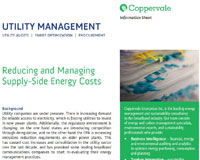 Info Sheet: UTILITY MANAGEMENT
Reducing and Managing Supply-Side Energy Costs.